
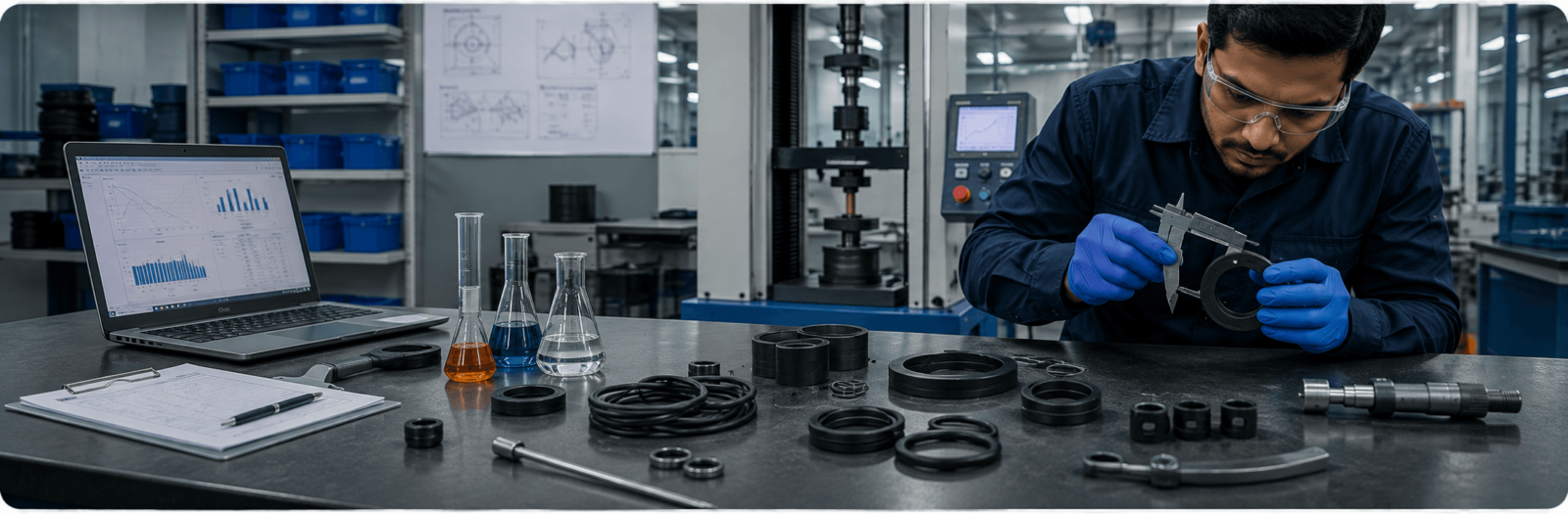
You have the CAD drawings. You’ve reviewed the material datasheets. On paper, the custom EPDM seal you’ve designed for your new fluid transfer system looks flawless. It meets the required durometer, the tensile strength is ideal, and it fits the assembly perfectly.
But rubber doesn’t operate on paper.
In the world of custom rubber manufacturing, the gap between theoretical design and real-world performance is where products either succeed or fail catastrophically. Relying solely on drawing board specifications is a risk no manufacturer can afford to take. That is why application validation—testing how a specific rubber compound performs in its actual end-use environment—is the most critical phase of product development.
Here is why engineering beyond the drawing board is what ultimately determines your product’s success.
Table of Contents
ToggleThe Illusion of “Standard Specs”
When selecting an elastomer, engineers often rely on standard ASTM lab data. While this data is an excellent starting point, lab conditions are intentionally isolated. A datasheet can tell you how a nitrile (NBR) compound reacts to oil at room temperature, but it cannot tell you how that same compound will behave when subjected to:
Simultaneous high-pressure spikes and severe temperature drops.
Friction from rapid dynamic cycling.
Exposure to trace, abrasive chemicals not listed in the primary fluid makeup.
Application validation bridges this gap. It takes the rubber out of the vacuum of a clean laboratory and subjects prototypes to the chaotic, compounding variables of the real world.
The Hidden Economics of an O-Ring
It is tempting to view rigorous application validation as a bottleneck. When deadlines are tight, spending weeks validating a simple gasket or vibration mount can feel like an unnecessary delay. However, skipping validation usually leads to a brutal lesson in economics known as the 1-10-100 Rule of Quality:
- $1 (Prevention): The cost of investing in upfront validation, custom compound tweaking, and prototype testing.
- $10 (Correction): The cost of discovering a failure during final assembly and having to redesign the tooling and halt production.
- $100 (Failure): The cost of a field failure.
In rubber manufacturing, a failed component is rarely just a broken piece of rubber. A degraded O-ring can cause a $50,000 hydraulic pump to seize. A prematurely aged vibration mount can lead to the structural failure of heavy machinery. Validation isn’t a delay; it is the ultimate insurance policy against recalls, warranty claims, and permanent brand damage.
Key Real-World Stressors That Demand Validation
To guarantee product success, a quality rubber manufacturer will work with you to validate components against the specific stressors of your application. The most critical include:
Compression Set Under Thermal Cycling: Will the rubber bounce back to its original shape after being compressed under extreme heat, or will it permanently flatten and cause a leak?
Dynamic vs. Static Stress: A rubber seal holding two stationary pipes together requires entirely different validation than a seal operating on a rapidly spinning shaft where friction generates localized heat.
Environmental Degradation: How does the component react to prolonged UV exposure, ozone generation from nearby electrical equipment, or high-humidity environments?
Swelling and Shrinkage: Immersion testing in the exact fluids (including proprietary blends and trace additives) the rubber will encounter is vital to ensure it doesn’t swell and blow out of its gland, or shrink and lose contact.
From Concept to Confidence
A successful rubber product isn’t just manufactured; it is heavily engineered and ruthlessly validated.
When you partner with a manufacturer, you need more than a company that can inject rubber into a mold. You need an engineering partner who asks the tough questions about your end-use environment, challenges your initial material assumptions, and insists on validating the application before full-scale production begins.
By prioritizing application validation, you ensure that the product you conceptualized on the drawing board performs exactly as intended in the field—delivering reliability, safety, and a flawless reputation for your brand.
Add a Comment