
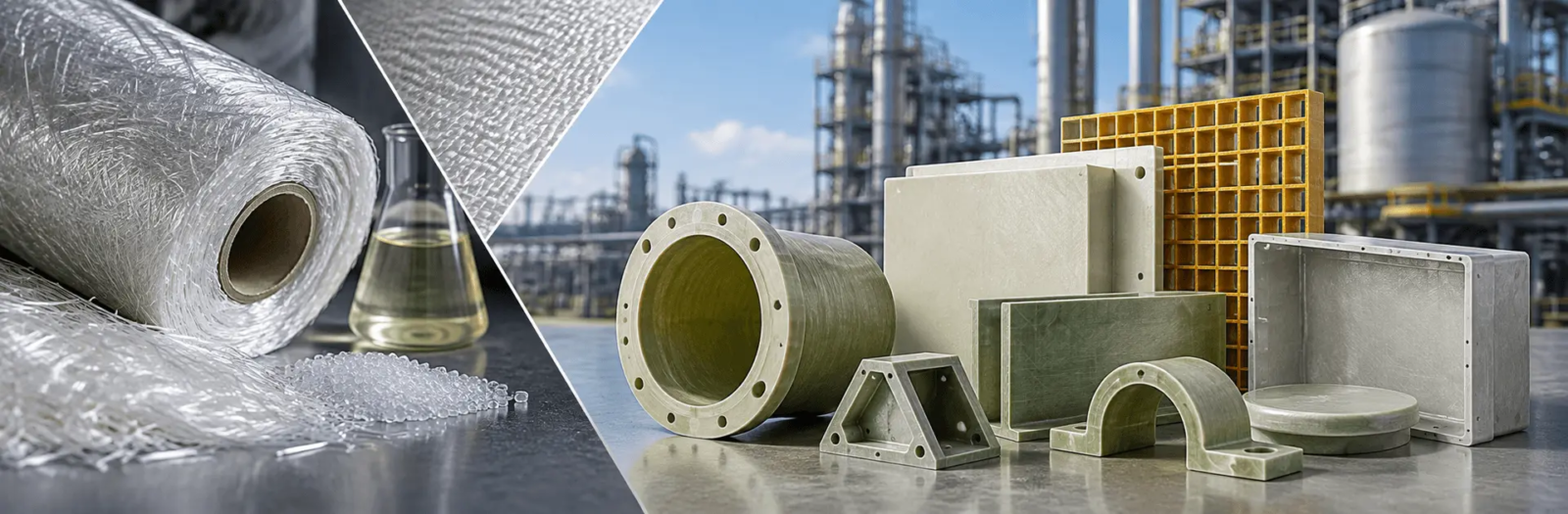
Industrial equipment operates in environments where components are exposed to demanding conditions such as moisture, chemicals, temperature variations, mechanical loads, and continuous operation. In such applications, selecting the right material can directly influence component performance, durability, maintenance requirements, and overall equipment reliability.
Fiber Reinforced Polymer (FRP) has become an important material option for industrial components because it combines a polymer matrix with reinforcing fibers to achieve useful properties such as corrosion resistance, strength-to-weight efficiency, and dimensional stability.
From structural components and covers to housings, panels, brackets, and custom industrial parts, FRP can be engineered for a wide range of applications. However, achieving reliable performance depends on more than simply choosing FRP as a material. The component must be designed according to its specific operating environment and functional requirements.
Table of Contents
ToggleWhy FRP Is Used in Industrial Components
FRP components offer a combination of properties that can be valuable in challenging industrial environments. Their corrosion resistance, relatively low weight, strength, and design flexibility make them suitable for applications where conventional materials may require additional protection or maintenance.
For example, in environments exposed to moisture or corrosive chemicals, FRP can help reduce corrosion-related deterioration. Its lower weight can also simplify handling, installation, and maintenance in applications where component mass is an important consideration.
However, FRP is not a one-size-fits-all solution. The reinforcement type, resin system, manufacturing process, geometry, and operating conditions must all be considered during component design.
Key Factors in FRP Component Design
- Application Requirements: The first step is understanding what the component needs to do. Load, movement, dimensional requirements, service life, and interaction with other components all influence the design.
- Material Selection: The resin and reinforcement system should be selected according to the operating environment. Chemical exposure, temperature, moisture, mechanical loading, and other conditions can influence material performance.
- Load and Stress Distribution: FRP components should be designed to handle expected loads without creating unnecessary stress concentrations. Component geometry, thickness, reinforcement orientation, and support conditions all play important roles.
- Environmental Resistance: Industrial components may encounter water, humidity, chemicals, UV exposure, dust, or temperature fluctuations. These factors should be evaluated before finalizing the material and design.
- Manufacturing Process: The selected manufacturing method should match the component’s geometry, production volume, dimensional requirements, and performance expectations.
- Dimensional Accuracy: Proper tolerances and dimensional control are essential when an FRP component needs to interface with shafts, fasteners, housings, machinery, or other assemblies.
- Testing and Quality Control: Inspection and testing help verify dimensional accuracy, material consistency, surface quality, and application-specific performance before components are deployed.
Designing for the Industrial Environment
The operating environment is one of the most important considerations when designing an FRP component.
A component used in a chemical-processing environment may require different material characteristics from one used in an outdoor industrial application. Similarly, an FRP cover, enclosure, structural bracket, or machine component may experience different combinations of mechanical and environmental stresses.
Engineers therefore need to evaluate factors such as:
- Operating temperature
- Mechanical and impact loads
- Chemical exposure
- Moisture and humidity
- UV exposure
- Vibration and movement
- Installation conditions
- Required service life
Designing around these conditions from the beginning helps reduce the risk of premature deterioration and improves the reliability of the finished component.
Geometry and Reinforcement Matter
One of the advantages of FRP is its flexibility in component design. However, this flexibility needs to be supported by proper engineering.
The geometry of an FRP component can influence how loads are distributed throughout the part. Areas such as corners, holes, mounting points, joints, and transitions may require additional design attention because they can experience concentrated stresses.
The orientation and quantity of reinforcing fibers can also influence the mechanical behaviour of the finished component. Therefore, reinforcement should be considered as part of the overall component design rather than as an isolated material decision.
This becomes particularly important for custom FRP components, where the design needs to balance performance, manufacturability, dimensional requirements, and cost.
When FRP Design Goes Beyond Material Selection
Choosing FRP does not automatically guarantee component reliability. A component can still underperform if its design does not match the actual application.
For example, selecting a corrosion-resistant material may address one environmental concern, but the component may still experience problems if its thickness, mounting arrangement, load capacity, or dimensional tolerances are unsuitable.
This is why industrial FRP design should consider the complete application rather than the material alone.
A reliable approach connects:
Application → Material → Geometry → Manufacturing → Testing → Performance
When these elements are considered together, FRP components can be developed with greater consistency and application-specific reliability.
The Business Value of Proper FRP Design
Effective FRP component design can provide benefits beyond material performance.
Corrosion resistance can help reduce corrosion-related maintenance in suitable environments. Lower component weight may simplify handling and installation. Custom designs can also allow manufacturers to integrate specific functional requirements into a single component.
At the same time, proper engineering and quality control can help reduce premature replacement, maintenance interruptions, and unexpected component failures.
The objective is not simply to manufacture an FRP component, but to develop a component that performs reliably within the conditions for which it was designed.
Reliability Starts With the Right Design
Industrial FRP components can offer valuable performance advantages when the material, design, manufacturing process, and operating environment are properly matched.
From corrosion-resistant industrial parts to custom housings, covers, brackets, panels, and structural components, FRP can be engineered to meet specific application requirements.
At Achievo Engineering, the focus should be on understanding the application first and then developing components around the required performance, dimensional, material, and manufacturing parameters.
Conclusion
Designing FRP components for industrial applications requires more than selecting a lightweight and corrosion-resistant material. Reliable performance depends on understanding the operating environment, selecting appropriate materials and reinforcement, designing for expected loads, maintaining dimensional accuracy, choosing the right manufacturing process, and implementing effective quality control.
When engineering decisions are made at the component-design stage, FRP can become more than an alternative material—it can become a practical solution for demanding industrial applications.
Add a Comment