
Table of Contents
ToggleWhy the insulation you choose matters
Inside every electric motor, transformer and heating element, insulation does a quiet but critical job. It keeps current where it belongs, even when temperatures climb and voltages spike.
When insulation fails, the result is rarely minor. It means short circuits, unplanned shutdowns, damaged equipment and safety risks on the shop floor.
Plastics and polymers work well in many applications. But when heat, arcing and long service life all come together, engineers keep returning to a material that has been used in electrical equipment for over a century: mica.
What is mica?
Mica is a group of naturally occurring silicate minerals. Its defining feature is a layered crystal structure that lets it split into extremely thin, flexible and transparent sheets.
Those layers are held together by weak bonds between them, but each layer is strong in itself. That combination is what makes mica both easy to process into thin insulation and tough enough to survive demanding service.
India has long been one of the world’s important sources of mica, and Indian manufacturers have deep experience processing it into components for electrical industries worldwide.
6 properties that make mica an outstanding insulator
- High dielectric strength. Even very thin mica withstands high voltages without breaking down, which saves space in compact designs.
- Excellent heat resistance. Mica keeps its insulating properties at temperatures where most plastics soften, char or melt.
- Resistance to arcing and corona. Mica is inorganic, so it resists the electrical discharges that slowly eat away organic insulation in high-voltage equipment.
- Low dielectric loss. It wastes very little energy as heat when exposed to alternating electric fields.
- Non-flammable and chemically stable. Mica does not burn, does not support flame and resists most oils, solvents and moisture.
- Dimensional stability. It holds its shape and thickness under heat and compression, so clearances and fits stay reliable over years of service.
Muscovite vs phlogopite: which mica do you need?
Two types of mica dominate electrical insulation. The right choice depends mainly on operating temperature and electrical demand.
| Muscovite mica | Phlogopite mica |
Composition | Potassium-aluminium mica | Potassium-magnesium mica |
Appearance | Clear, silvery to light ruby | Amber to brown |
Electrical properties | Superior: higher dielectric strength, lower loss | Very good |
Heat resistance (approx., continuous) | Up to about 500–550 °C | Up to about 800–900 °C |
Mechanical | Harder, stiffer | Softer, more flexible |
Best suited to | Motors, transformers, switchgear, electronics | Furnaces, heating elements, high-heat industrial equipment |
Rule of thumb: choose muscovite when electrical performance comes first, and phlogopite when extreme heat is the bigger challenge. Final ratings also depend on the binder used in the sheet, so always confirm against the material datasheet.
The forms mica insulation comes in
Natural mica blocks are rarely large or uniform enough for industrial parts. So most insulation today is made from built-up mica: thin mica splittings or mica paper bonded with a resin, then pressed into sheets of a controlled thickness.
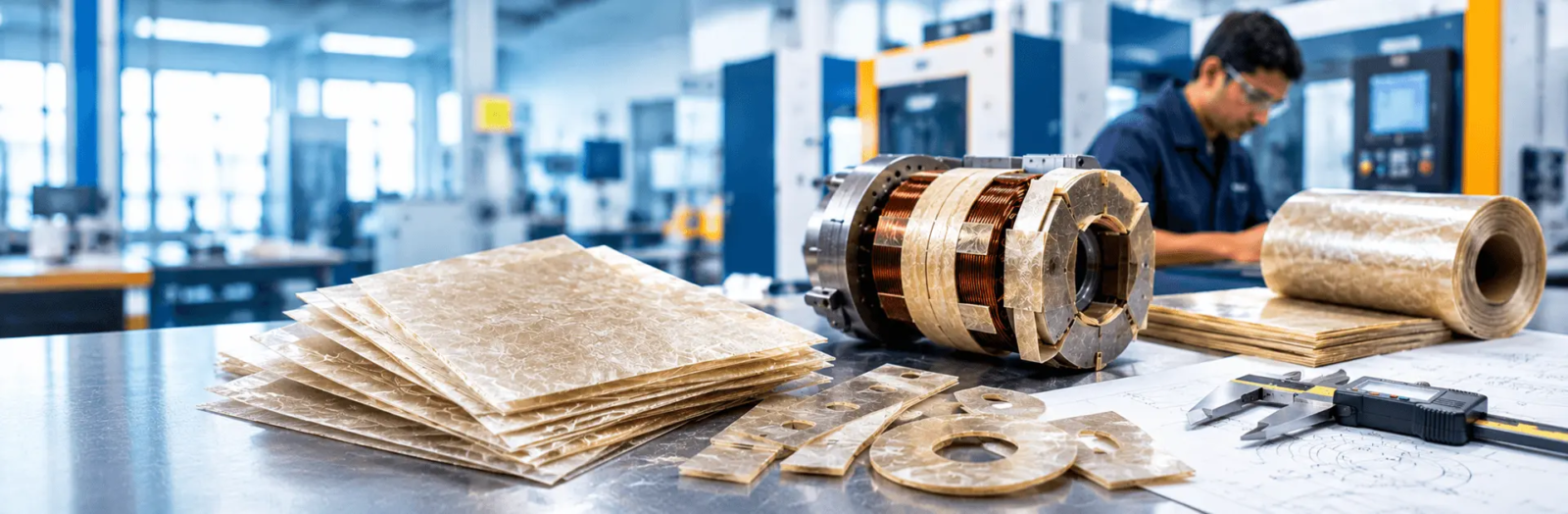
- Rigid mica sheets are pressed hard and dense. They are ideal for machined parts such as washers, spacers, plates and heater supports.
- Flexible mica sheets use binders that let the sheet bend without cracking. They suit wrapping, lining and forming around curved surfaces.
- Mica paper and tapes are made from finely ground mica formed like paper. They are widely used to wrap conductors and coils in motors and generators.
The binder matters as much as the mica. Silicone binders generally allow higher operating temperatures, while other resins may offer better mechanical strength or lower cost.
Where mica insulation is used
Mica components show up wherever electricity and heat meet.
Component | What it does | Typical equipment |
Mica washers | Isolate fasteners and terminals from live or hot parts | Motors, switchgear, power electronics |
Mica gaskets | Seal and insulate joints at high temperature | Heaters, furnaces, exhaust and thermal systems |
Mica rings | Insulate rotating and stationary parts | Motors, transformers, commutators |
Mica spacers | Hold precise gaps between conductors | Bus bars, control panels, power distribution |
Insulation strips | Line slots, channels and conductors | Bus bars, railway electrical systems |
Mica sheet cuttings | Custom profiles with holes and cut-outs | Heating elements, renewable energy equipment, OEM assemblies |
Key industries include electric motors, transformers, switchgear and control panels, industrial furnaces and heaters, railway electrical systems and renewable energy equipment.
5 things to get right when specifying mica parts
- Operating temperature. State the continuous and peak temperature. This decides between muscovite and phlogopite, and which binder to use.
- Voltage and clearance. Share the working voltage and required creepage distances so the right thickness can be selected.
- Rigid or flexible. Machined parts need rigid sheet. Wrapped or formed parts need flexible grades.
- Thickness tolerance. Mica sheets vary slightly in thickness. If your assembly depends on a tight stack-up, call out the tolerance on the drawing.
- Edge quality and hole positions. Mica is layered, so poor cutting can cause chipping or delamination. Precise holes and clean edges need the right tooling and machining method.
How Achievo makes precision mica components
At Achievo Engineering, we manufacture mica insulation components to customer drawings, using dedicated CNC routing to produce intricate profiles, slots, holes and cut-outs with consistent accuracy.
- Materials: muscovite and phlogopite mica, in rigid and flexible sheets of multiple thicknesses
- Products: mica washers, gaskets, rings, spacers, insulation strips and custom sheet cuttings
- Volumes: from prototypes to full production runs
- Process: customer drawing → material selection → CNC programming → precision machining → inspection → packaging and delivery
- Quality: in-process and final inspection, backed by ISO 9001:2015, ISO 14001:2015 and ISO 45001:2018 certified systems
With over 50 years of manufacturing experience and customers across Europe, the Middle East and the USA, we help OEMs get insulation parts that fit right the first time and perform for years.
Need a custom mica component? Share your drawing or requirements and our team will recommend the right material and get back with a quote. Request a quote →
Frequently asked questions
Is mica a good electrical insulator? Yes. Mica combines high dielectric strength, low dielectric loss and excellent resistance to heat and arcing, which is why it is used in motors, transformers and heaters.
What temperature can mica insulation withstand? It depends on the type and binder. Muscovite-based sheets are typically used up to about 500–550 °C, and phlogopite-based sheets up to about 800–900 °C. Check the datasheet for the exact grade.
What is the difference between muscovite and phlogopite mica? Muscovite offers better electrical properties and stiffness. Phlogopite handles higher temperatures and is softer.
Can mica components be made to custom sizes? Yes. Achievo machines washers, spacers, rings, gaskets, strips and complex profiles to your drawing, in prototype or production quantities.
Why choose mica over plastic insulation? Mica does not burn, melt or degrade under arcing, so it lasts longer where heat and high voltage occur together.
Add a Comment