
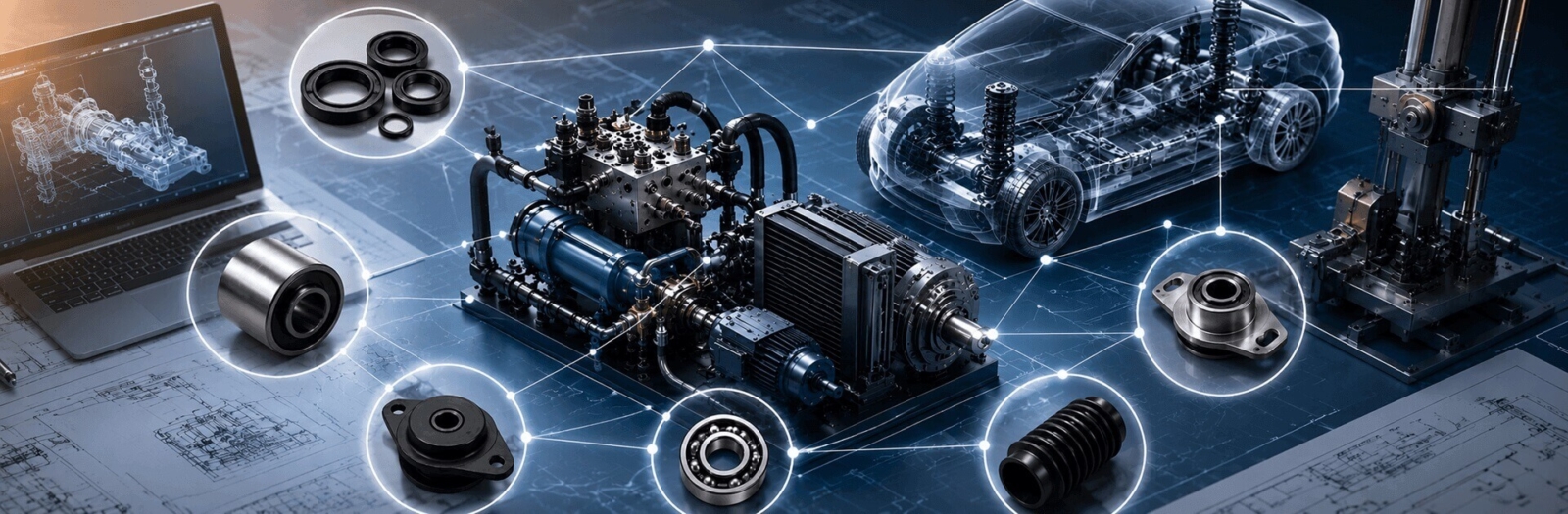
Modern engineering systems are built from several interrelated parts. Whether it is an industrial machine, manufacturing line, automobile assembly or hydraulic system, how well these parts cooperate determines how well the system performs. A part can perform perfectly in isolation and still contribute to system failure when its interaction with other parts are overlooked. For this reason, the importance of system-level engineering is growing.
Table of Contents
ToggleWhy Individual Parts Aren’t Enough
Optimizing individual components is important, but it does not guarantee overall system performance. A component may meet strength, durability, temperature or pressure requirements during testing, yet fail when exposed to real-world conditions.
For example, a high-quality rubber seal may have excellent heat and chemical resistance. However, incorrect shaft dimensions, poor surface finish, misalignment, excessive vibration or unsuitable lubrication can reduce its service life.
The key issue is not always the component itself, it is how the component interacts with the rest of the system.
Reasons Why System-Level Engineering Matters
1. Components Influence Each Other
Every component operates within a network of mechanical, thermal, electrical or material interactions. Changes to one part can affect the performance of others.
2. Improves Overall Reliability
System-level analysis helps engineers identify potential failure points caused by component interactions, reducing unexpected breakdowns and maintenance requirements.
3. Accounts for Real-World Conditions
Laboratory performance does not always represent actual operating conditions. System-level engineering considers factors such as:
- Temperature
- Pressure
- Friction
- Vibration
- Load
- Alignment
- Lubrication
- Environmental exposure
4. Reduces Costly Redesigns
Identifying compatibility and performance issues during the design stage can prevent expensive modifications after manufacturing or installation.
5. Optimizes Total System Performance
Simply, the goal is not to make individual components stronger or faster. It is to create the right balance between performance, durability, efficiency, manufacturability and cost.
6. Supports Predictive Maintenance
Understanding how components interact makes it easier to predict how wear or failure in one part could affect connected components, enabling more effective maintenance planning.
A Practical Example: Automotive Systems
Consider an automotive suspension system. The performance of a shock absorber depends on much more than the absorber itself. Springs, bushings, mounts, suspension geometry, vehicle weight, road conditions and damping characteristics all influence the final result.
Improving only one component without considering the complete suspension system may provide limited benefits. A system-level approach ensures that all components are designed and selected to work together.
The Importance of Cross-Functional Engineering
System-level engineering also requires collaboration between different teams. Design engineers, material specialists, manufacturing teams, testing engineers and quality professionals need to work together.
Modern simulation tools, testing data, and real-world feedback make it possible to understand component interactions earlier in the product-development process.
Instead of asking, “Is this component good enough?”, engineers should ask:
“Will this component perform effectively within the complete system?”
Conclusion
Individual components remain fundamental to engineering, but their true performance depends on the environment in which they operate. As machines become more sophisticated and interconnected, focusing only on isolated parts can overlook critical performance and reliability issues. System-level engineering connects components, materials, processes and operating conditions to create a better-performing whole.
Add a Comment