
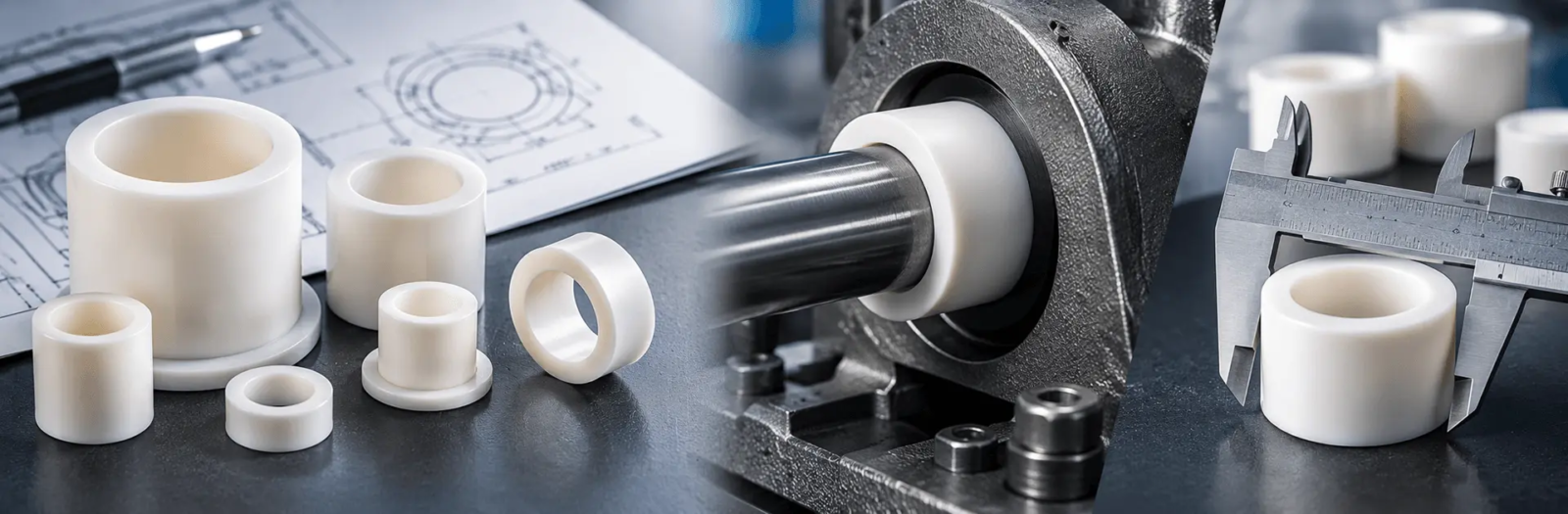
In industrial machinery, small components often have a major influence on overall performance. PTFE bushes are one such component. Used to support moving parts, reduce friction, and provide reliable movement between components, PTFE bushes can be found across applications involving shafts, pins, linkages, hydraulic systems, automotive assemblies, and industrial machinery.
While PTFE is well known for its low coefficient of friction, chemical resistance, and temperature performance, material selection alone does not determine how well a PTFE bush will perform.
The dimensions of the bush—including inner diameter, outer diameter, length, wall thickness, and tolerances—must be matched carefully to the application.
Table of Contents
ToggleA Small Dimensional Difference Can Create a Big Problem
A PTFE bush may look like a simple cylindrical component, but its dimensions determine how it fits and interacts with the surrounding assembly. Even a small dimensional error can affect clearance, friction, movement, load distribution, and wear.
If the internal diameter is too small, the shaft may experience excessive resistance or difficulty during movement. If the clearance is too large, unwanted movement, vibration, or uneven loading can occur.
This demonstrates an important engineering principle: precision is not simply about achieving a measurement; it is about achieving the right measurement for the application.
Key PTFE Bush Dimensions That Matter
- Inner Diameter: The inner diameter determines how the bush interfaces with the shaft, pin, or moving component. Proper clearance is essential for smooth movement and effective performance.
- Outer Diameter: The outer diameter determines how the bush fits into its housing or mounting location. An incorrect outer diameter can result in poor retention or installation difficulties.
- Length: Bush length influences the contact area between the bush and shaft. Depending on the application, incorrect length can affect load distribution and stability.
- Wall Thickness: Wall thickness affects the strength, stiffness, and dimensional stability of the bush. It must be suitable for the available installation space and operating loads.
- Tolerances: Manufacturing tolerances define the acceptable dimensional variation. Proper tolerances help ensure consistency between the bush and the components it interacts with.
- Clearance: The working clearance between the bush and shaft is particularly important. It needs to account for operating temperature, load, movement, and the characteristics of the selected PTFE material.
Why Clearance Is Critical
Clearance is one of the most important considerations when specifying PTFE bushes.
Unlike a simple press-fit component, a bush supporting a moving shaft needs enough clearance to allow proper movement under actual operating conditions. At the same time, excessive clearance can introduce unwanted play and affect system performance.
The correct clearance depends on several factors, including:
- Shaft diameter
- Operating temperature
- Applied load
- Speed of movement
- Bush material and grade
- Housing dimensions
- Operating environment
- Expected service life
Therefore, PTFE bush dimensions should be specified according to actual working conditions rather than based only on nominal shaft and housing dimensions.
When Incorrect Dimensions Affect Machine Performance
A dimensional mismatch can create problems throughout an assembly.
For example, excessive clearance between a PTFE bush and shaft may allow additional movement. Over time, this can contribute to uneven wear, vibration, noise, or reduced positioning accuracy.
On the other hand, insufficient clearance can increase resistance to movement and may cause problems during operation, particularly when temperature changes or loads affect the components.
Similarly, an incorrect outer diameter can affect how securely the bush sits inside its housing.
A component that is dimensionally correct on paper but incorrectly specified for its operating conditions may still fail to deliver the expected performance.
Material and Dimensions Work Together
PTFE is valued for properties such as low friction, chemical resistance, and good temperature resistance. However, different PTFE compounds and filled grades can behave differently under load and operating conditions.
This means material selection and dimensional design should be considered together.
For demanding applications, engineers may need to evaluate factors such as:
- Load and pressure
- Sliding speed
- Temperature
- Chemical exposure
- Shaft material and surface finish
- Housing material
- Lubrication requirements
- Operating cycle
- Expected service life
The right PTFE grade combined with appropriate dimensions can help create a more reliable bearing or bush arrangement.
Precision Manufacturing Matters
Accurate design specifications must be supported by consistent manufacturing.
Producing PTFE bushes to the required dimensions requires control over machining, tolerances, surface finish, and inspection. This becomes particularly important for custom PTFE bushes, where standard dimensions may not match the requirements of a specific machine or assembly.
Quality inspection can help verify critical dimensions such as internal diameter, outer diameter, length, and other application-specific parameters before the components are delivered.
The Business Impact of Correct Bush Dimensions
Correctly specified PTFE bushes can contribute to smoother movement, reduced friction, improved component compatibility, and more predictable maintenance requirements.
Conversely, incorrect dimensions can result in installation problems, premature wear, machine downtime, and repeated component replacement.
For manufacturers and equipment operators, this makes dimensional accuracy more than a manufacturing specification—it is an important part of total component reliability and operating cost.
Reliability Starts With the Right Specification
A PTFE bush should not be treated as a generic off-the-shelf component when the application has specific performance requirements.
Before finalizing dimensions, engineers should consider:
- What shaft or pin will the bush support?
- What housing will it fit into?
- What load will it experience?
- What movement and speed are expected?
- What temperature range will it operate in?
- What level of clearance is required?
- What PTFE grade is suitable?
- What tolerances are necessary?
Answering these questions helps ensure that the final bush is designed around the actual application.
Conclusion
PTFE bushes may be relatively simple components, but their dimensions can have a significant impact on machinery performance. Inner diameter, outer diameter, length, wall thickness, tolerances, and operating clearance all influence how effectively a bush performs within an assembly.
The right PTFE material provides the foundation. The right dimensions make it work within the system.
By combining application-specific material selection, accurate dimensional design, controlled manufacturing, and proper quality inspection, manufacturers can develop PTFE bushes that deliver reliable performance across demanding industrial applications.
Add a Comment