
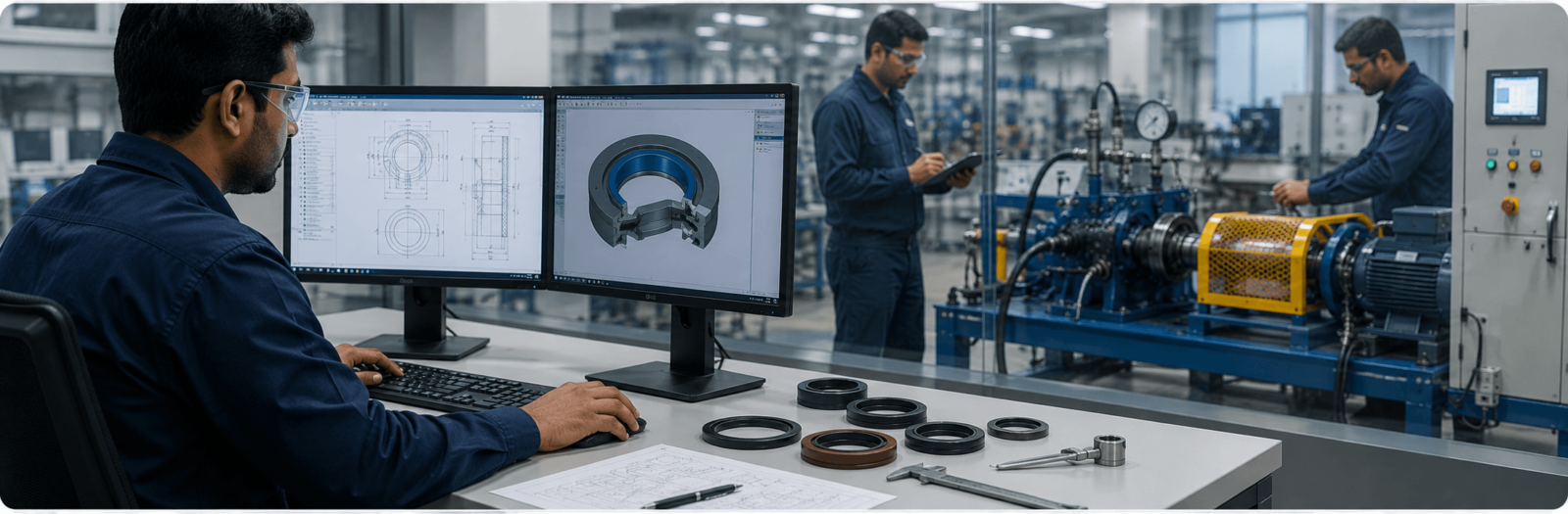
A well-designed product begins with a great idea. It evolves through thoughtful engineering, careful prototyping and rigorous testing. But the true measure of success isn’t whether the prototype works in the lab—it’s whether the product performs consistently in the real world.
This is where application validation becomes one of the most critical, yet often overlooked, stages of product development.
Table of Contents
ToggleWhat is Application Validation?
Application validation is the process of verifying that a component or assembly performs reliably under its actual operating conditions—not just under ideal testing environments.
A component may meet every dimensional specification and pass visual inspection, but still fail prematurely if the real-world application wasn’t fully understood during development.
Understanding the Operating Environment
Every product operates under a unique set of conditions. Before finalizing the design, engineers should evaluate factors such as:
- Operating temperature and thermal cycling
- Internal or external pressure
- Torque and mechanical loads
- Friction and wear characteristics
- Chemical exposure
- UV and weather resistance
- Fire or non-flammability requirements
- Environmental sealing requirements
These parameters directly influence material selection, manufacturing processes and long-term product reliability.
Why Good Designs Still Fail
Many product failures are not caused by manufacturing defects—they originate much earlier in the development process.
Common reasons include:
- Selecting materials without considering the operating environment
- Designing components that are difficult to assemble consistently
- Insufficient prototype validation under actual working conditions
- Transitioning to production without evaluating process capability
- Optimizing for cost without understanding long-term performance requirements
Addressing these challenges early significantly reduces redesign, warranty claims and field failures.
The Importance of Design for Manufacturing and Assembly
Successful products are not only functional—they are also practical to manufacture and assemble.
Early collaboration between product designers and manufacturing engineers helps identify opportunities to:
- Simplify component geometry
- Reduce assembly complexity
- Improve manufacturability
- Optimize tolerances
- Enhance repeatability
- Lower production costs
Integrating manufacturing knowledge during the design stage not only improves product quality but also enables cost optimization by reducing material waste, minimizing rework and improving process efficiency.
From Prototype to Reliable Production
A working prototype answers one important question:
“Does the concept work?”
Production asks additional questions:
- Can the product be manufactured consistently?
- Will every component perform under real operating conditions?
- Can assembly be carried out efficiently?
- Is the process capable of supporting higher production volumes?
- Will quality remain consistent over time?
Another critical consideration is how quickly the product can scale from prototype to production. Delays in scaling often lead to missed market opportunities and increased development costs.
By validating application requirements and manufacturing processes early, organizations can significantly reduce the time required to scale up production, ensuring a smoother and faster transition to volume manufacturing.
Building Products That Last
Successful product development goes beyond creating components that meet drawings. It requires developing products that perform reliably throughout their service life.
By validating application requirements early, selecting appropriate materials, designing for manufacturing and assembly, and planning for scalability from the beginning, organizations can:
- Reduce development risks
- Optimize overall product cost
- Shorten time-to-market
- Improve long-term reliability
Conclusion
Engineering does not end when the design is completed. In many ways, that is where the real journey begins.
Application validation bridges the gap between concept and commercial success by ensuring that products perform as intended in the environments for which they were designed—while also enabling cost-effective production and faster scale-up.
At Achievo Engineering Components, we partner with OEMs throughout this journey—from design support and rapid iterative prototyping to application validation and scalable manufacturing. Our objective is simple: to help transform innovative ideas into reliable, cost-efficient products that succeed in the real world.
Add a Comment