
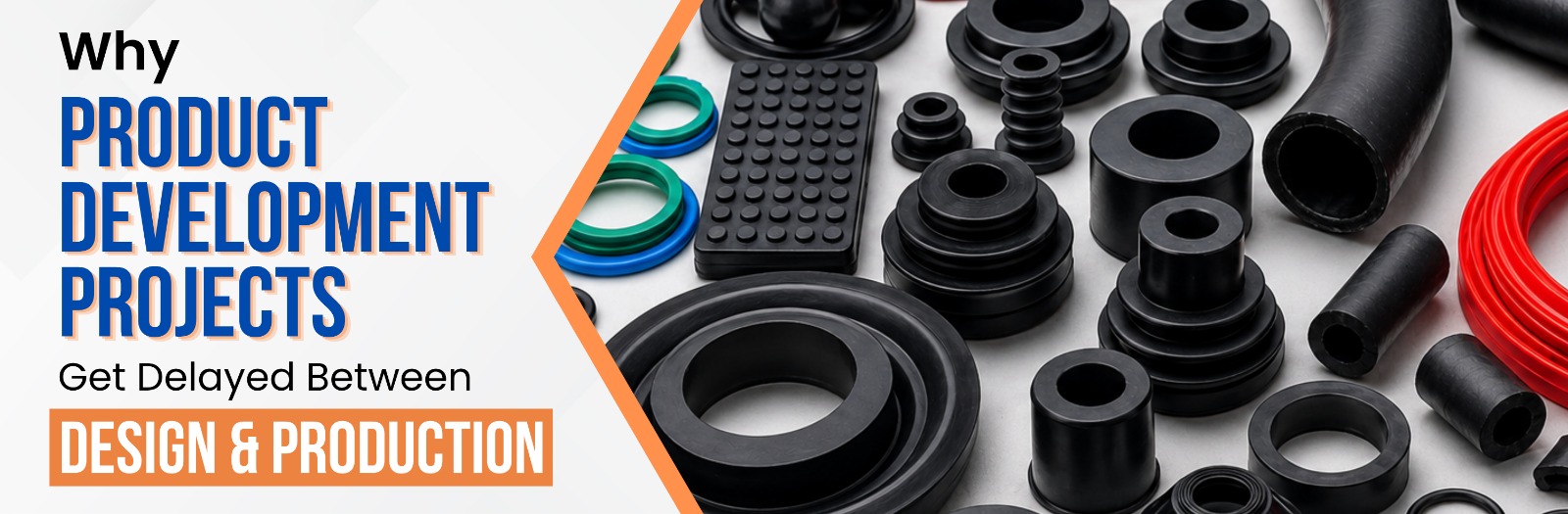
Many product development projects start with a promising concept and a well-thought-out design. Yet, despite the best intentions, delays often occur during the transition from design to production.
Interestingly, the challenge is rarely the design itself. The real challenge lies in converting a design into a manufacturable, scalable and reliable product that performs consistently in real-world conditions.
Table of Contents
Toggle1. Frequent Design Changes
As prototypes are tested, new requirements emerge. Engineers identify improvements, users provide feedback, and components need refinement.
Design changes are a natural part of product development. The ability to rapidly incorporate these changes through iterative prototyping can significantly reduce overall project timelines.
2. Limited Manufacturing Involvement
Many products are designed first and handed over to manufacturing later.
This often results in:
- Difficult-to-manufacture features
- Higher production costs
- Longer lead times
- Unexpected quality issues
Early involvement of manufacturing teams helps identify potential challenges before they become expensive problems.
3. Prototype-to-Production Gap
A prototype that works successfully in testing may not always be suitable for mass production.
Material selection, tolerances, tooling requirements and process capabilities must all be evaluated before scaling production.
Bridging this gap requires close collaboration between design and manufacturing teams.
4. Managing Multiple Technologies
Modern products often combine rubber, plastic and metal components within a single assembly.
Coordinating multiple suppliers during development can increase complexity and extend timelines.
Working with partners who understand multiple manufacturing technologies can simplify development and improve speed.
5. Assembly Challenges at the User End
Even when components are manufactured correctly, issues can arise during assembly at the customer’s facility.
Common challenges include:
- Components that are difficult to assemble or require excessive force
- Misalignment due to tight tolerances or inconsistent dimensions
- Lack of clarity in assembly procedures
- Increased assembly time leading to higher operational costs
Designing with assembly in mind—often referred to as Design for Assembly (DFA)—helps ensure that products are easy to handle, fit and install in real-world conditions.
6. Overlooking Application Parameters
A design that performs well in controlled testing may fail when exposed to actual operating conditions.
Critical application parameters are sometimes underestimated or not fully validated, such as:
- Torque requirements
- Temperature variations
- Pressure conditions
- Friction and wear behavior
- Non-flammability or safety requirements
Ignoring these factors can lead to premature failures, performance issues or compliance risks once the product is deployed.
Early validation of these parameters during prototyping helps ensure that the final product performs reliably in its intended environment.
7. Scalability Considerations
Many development projects focus on proving the concept.
However, production success requires answering additional questions:
- Can the design be manufactured consistently?
- Can quality be maintained at higher volumes?
- Can lead times remain predictable?
Considering scalability early in the development process reduces future risks.
Conclusion
Successful product development is not just about creating a functional design. It is about creating a design that can be validated, manufactured, assembled and scaled efficiently under real-world conditions.
Organizations that integrate design, prototyping, application validation and manufacturing expertise early in the process often reduce development time, improve product quality and accelerate commercialization.
At Achievo, we support OEMs through design support, rapid iterative prototyping and scalable manufacturing solutions, helping bridge the gap between concept and production.
Add a Comment